 by
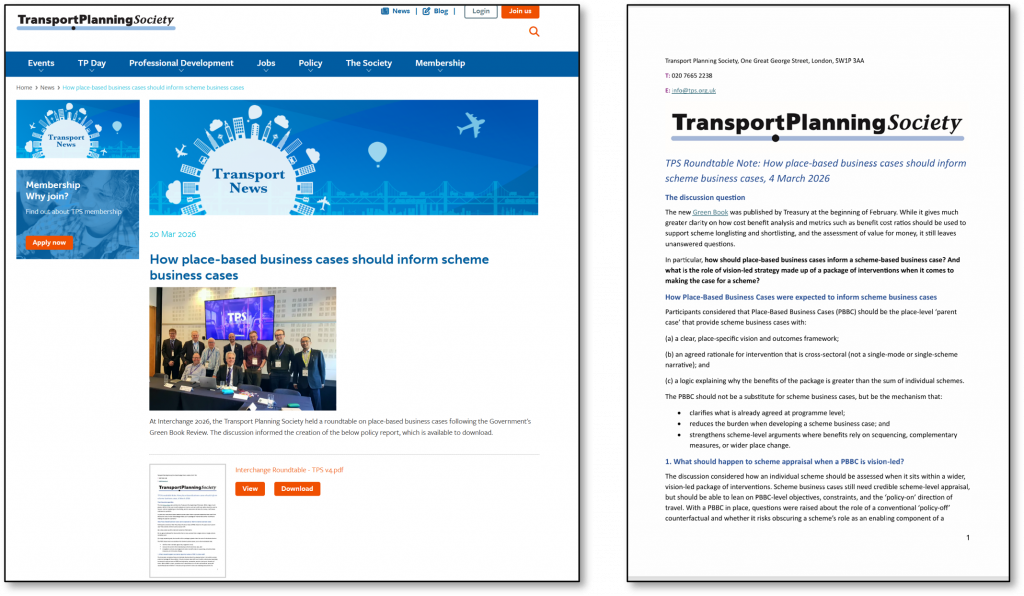
by A new note from the Transport Plannning Society sets out what PBBCs ought to do. Graham adds some background and his own perspectives.
The Transport Planning Society (TPS) has produced a thoughtful short note on how place-based business cases (PBBCs) should work, and what they should contain in order to most effectively feed into scheme business cases.
In this post I’ll give some background on the PBBC concept and how it came about, as well as some of my own perspectives, as an introduction to the TPS note.
What’s it all about?
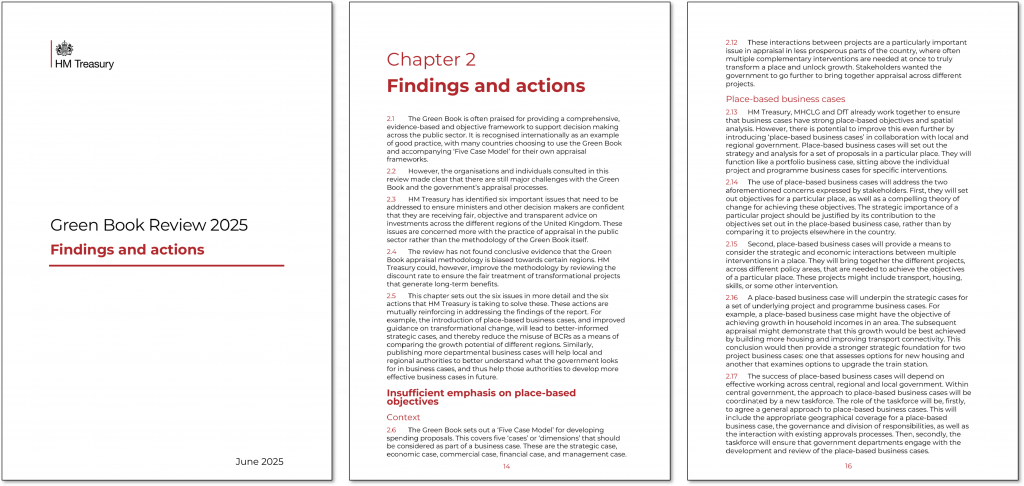
Place-based business cases (not to be confused with place-based appraisal, which is a different concept) were an action that emerged from last year’s Green Book review.
The idea of a PBBC is to set out the strategy and analysis for a set of proposals – perhaps across a range of different policy areas, such as housing, transport or skills – in a particular place. It would describe the objectives for that place, and say how the projects or programmes will interact and support each other to deliver the objectives. It would sit above their individual business cases, but would also be the foundation for their strategic cases.
The UK Department for Transport (DfT), Ministry of Housing, Communities and Local Government (MHCLG) and Treasury are piloting the PBBC approach in four ‘early adopter’ locations: Plymouth, Liverpool, Birmingham Sports Quarter and Port Talbot. We can expect guidance on PBBCs to follow, based on experience from these pilots[1].
The TPS note has plenty of useful ideas for shaping that guidance, which I hope the government will take on board. It’s based on a round-table discussion, held at the recent Interchange UK conference, under the aegis of the TPS’s Policy Panel – specifically its Governance, Appraisal, Business Case and Modelling group (of which I am a member). I couldn’t be at the event but was glad to contribute to the note.
What’s been the problem?
According to the Green Book review, the need for PBBCs comes from two concerns that stakeholders had expressed. First:
“while successive governments have pursued regional equality objectives, these objectives are not always properly reflected in the strategic cases for relevant proposals. By design, business cases typically answer the question “what is the best way to undertake this project?”, rather than “what is the right project to improve growth in this area?”
It is true that strategic cases don’t always properly reflect regional equality objectives where they exist. But this, to me, shows a weakness in the individual case-making, not necessarily in the system. It is perfectly possible to write a strategic case that shows how a scheme contributes to an area’s growth objectives and/or regional equality, and sets out the synergies with other schemes. And the ‘by design’ comment is surprising: a business case done properly, as the Treasury guidance reminds people, starts with the objectives and looks at the full range of policy instruments or projects that could be used.[2] This is one of those areas where you can have all the guidance or types of business case that you like, but it’s the approach or mindset that really matters.[3]
The second concern is a rather better basis. Stakeholders said the appraisal system didn’t properly reflect how individual projects were mutually reinforcing. The review put it like this:
“…stakeholders noted that it was often hard to express the strategic contribution of an individual project in a single project business case. This is because the Green Book is generally written to support the appraisal of individual projects and programmes. However, the benefits of different projects in a place, such as transport and housing, are often mutually reinforcing and greater than the sum of their parts. Appraisals can sometimes neglect the important interactions that exist between these different projects. Stakeholders often felt that they had to justify the strategic contribution of projects through social cost-benefit analysis. This can pose a difficult analytical task, especially for public bodies with smaller analytical teams.
“These interactions between projects are a particularly important issue in appraisal in less prosperous parts of the country, where often multiple complementary interventions are needed at once to truly transform a place and unlock growth. Stakeholders wanted the government to go further to bring together appraisal across different projects.”
In such circumstances, taking an isolated view of an individual scheme, as if it stood alone, would miss part of the story. But decision-makers do need to have confidence in the whole.
Thus where there are complex problems that need tackling from a range of directions, it is valuable to have a top-level document showing the logic of why each element matters, how they all contribute to the whole, and how they mutually reinforce. It can also save each element from re-inventing some of the wheel.
I wonder if the problem really boils down to:
- The logic exists in local leaders’ minds, but is not articulated in documentation – or at least, not in the language of appraisal (x leads to y leads to z: what the jargon calls a ‘theory of change’).
- Without that help, a strategic case writer may struggle to articulate the logic and interactions, especially if they are not familiar with the area and its thinking, or they are not a business case specialist who is alert to the need to do this. Just ‘dumping in’ material from previous documents, that weren’t written with business case logic in mind, won’t always work.
- A reviewer or decision-maker doesn’t have that local unwritten knowledge, and can’t be expected to magically guess it or to read-in arguments that aren’t there.
There are, of course, existing ‘strategic’ documents: most places in England have a local plan, a local growth plan, and often others with titles such as ‘place strategy’, ‘shared ambition’ or similar. But these reflect their own purposes and don’t necessarily provide a theory of change. The TPS note wisely sees the role of PPBCs as not duplicating these, but rather adding business case rigour to the narrative.

Another new flavour of ‘business case’
That’s all about the strategic case. The Green Book review said that PBBCs would follow the five-case model and may include cost-benefit analysis. I’m cautious about the latter. There may well be value in demonstrating that the whole effort generates quantified and monetised benefits sufficient to justify the cost, but this risks the PBBC’s economic case turning into the ‘business case for everything’, and perhaps re-creating the too-much-focus-on-the-numbers problem that PBBCs are supposed to solve. A better approach, as the TPS note sensibly suggests, is for the PBBC to be a place to set expectations for how schemes should describe their contribution to the whole.
The note also has some thoughtful comments about how the PBBC’s management case can also add value rather than duplicate.
More generally, I think it has the right idea by envisaging PPBCs as a place-level ‘parent case’ that provide scheme business cases with:
- A clear, place-specific vision and outcomes framework
- An agreed rationale for intervention that is cross-sectoral (not a single-mode or single-scheme narrative)
- A logic explaining why the benefits of the package is greater than the sum of individual schemes
They should not be a substitute for scheme business cases, it continues, but should be the mechanism that:
- Clarifies what is already agreed at programme level
- Reduces the burden when developing a scheme business case
- Strengthens scheme-level arguments where benefits rely on sequencing, complementary measures, or wider place change
Here again is the link to the note. Do take a look.
[1] Journalistic readers will doubtless at this point be reciting: “There were scenes of delight in Port Talbot tonight, as news of the business case spread…”
[2] See, for example, page 29 of the Green Book’s Guide to developing the project business case, https://assets.publishing.service.gov.uk/media/66449468ae748c43d3793bb8/Project_Business_Case_2018.pdf
[3] The DfT’s new integrated transport strategy ‘Better Connected’ has acknowledged this in the transport world: https://assets.publishing.service.gov.uk/media/69ce2f0bb5210036050bc6d7/dft-better-connected-strategy.pdf (see page 68)