 by
by Graham takes a look at a different aspect of investment appraisal
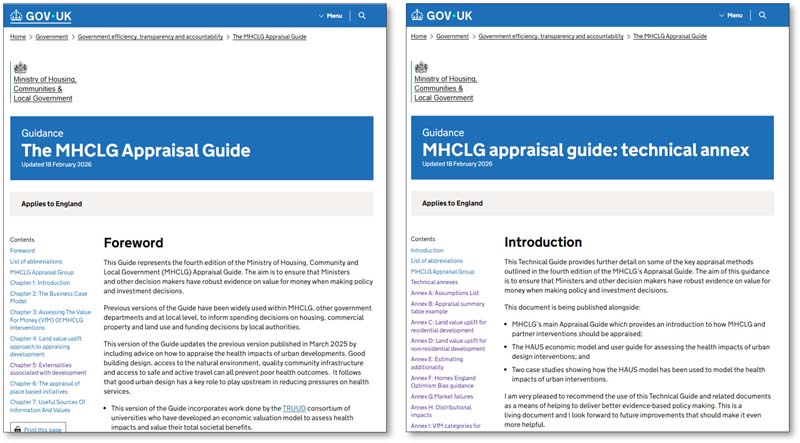
Last week the Ministry of Housing, Communities and Local Government (MHCLG) published its updated Appraisal Guide.
In the same way as the Department for Transport’s (DfT’s) Transport Analysis Guidance (TAG) takes the Treasury Green Book principles and applies them to appraising transport projects or policies, the MHCLG Appraisal Guide does so for things within the MHCLG’s policy remit.
In the transport world, we do sometimes dip into this one. One of the more common reasons is that the TAG method for estimating dependent development benefits (one of the types of wider economic impacts) draws on the MHCLG guidance for estimating land-value uplift.
And a few years ago the MHCLG-funded Housing Infrastructure Fund (HIF), via Homes England, paid for a number of transport schemes to unlock housing sites. As you would expect, the business cases for these were often produced by transport appraisal specialists – who had to follow the MHCLG guidance for these. Of course, the basic principles are similar. And the process works both ways: the MHCLG guidance points to TAG for appraising transport-specific impacts.
The key updates to the guide, according to MHCLG, are:
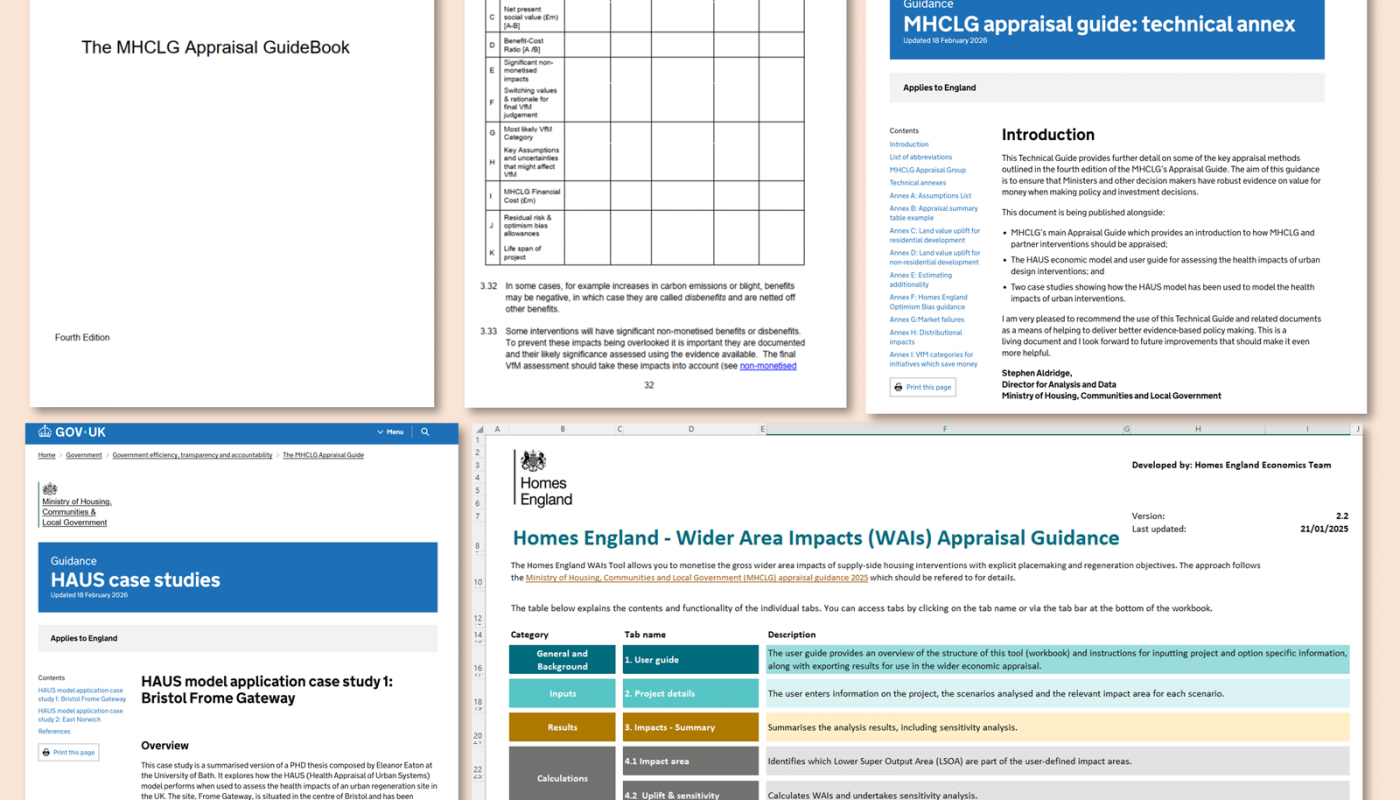
- A new technical annex
- A new methodology for valuing health impacts of developments
- Changes to the metrics used for reporting value for money, with a greater focus on the level of confidence in the analysis.
The updated Appraisal Guide itself is helpfully available as both a PDF and HTML. The new Technical Annex (HTML only) is actually the guide’s previous annexes, now split out into a separate file from the main text. Some of its material – such as appraisal periods or the treatment of inflation – is actually very widely relevant, so it shouldn’t be ignored. The two documents really go together.
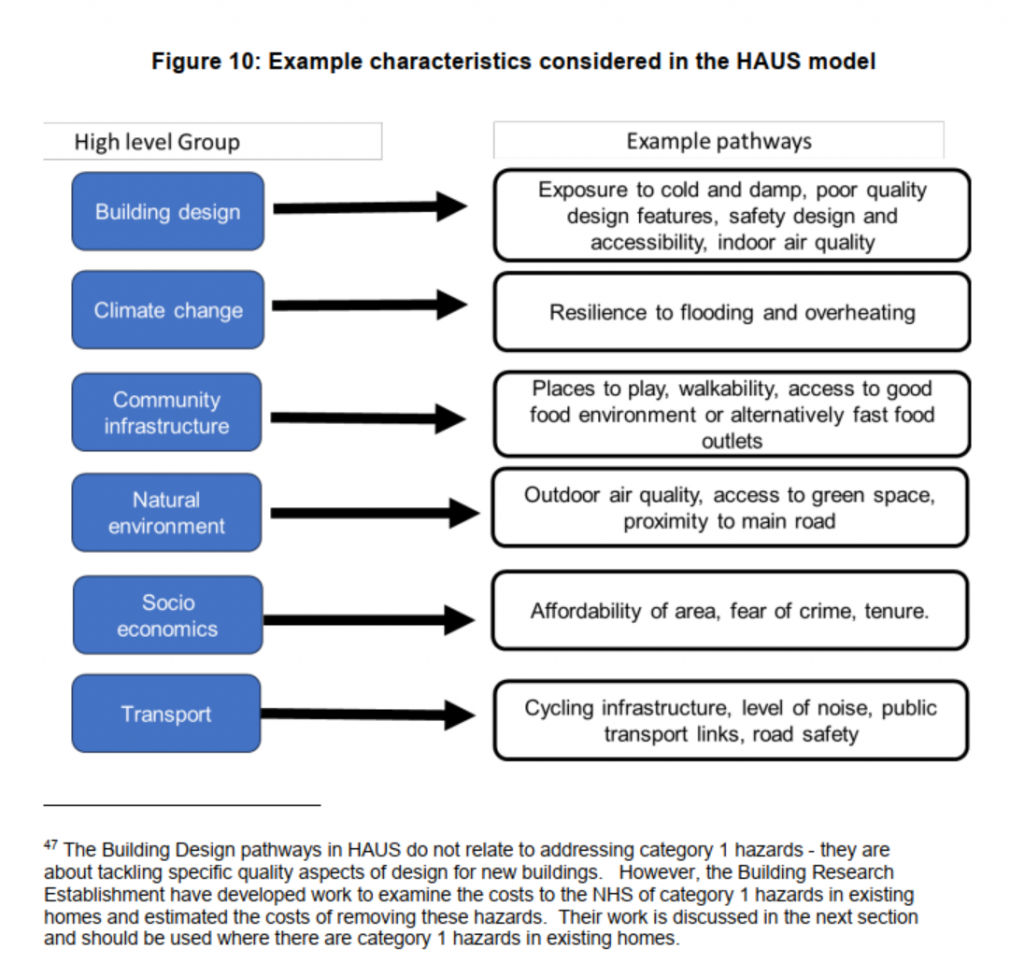
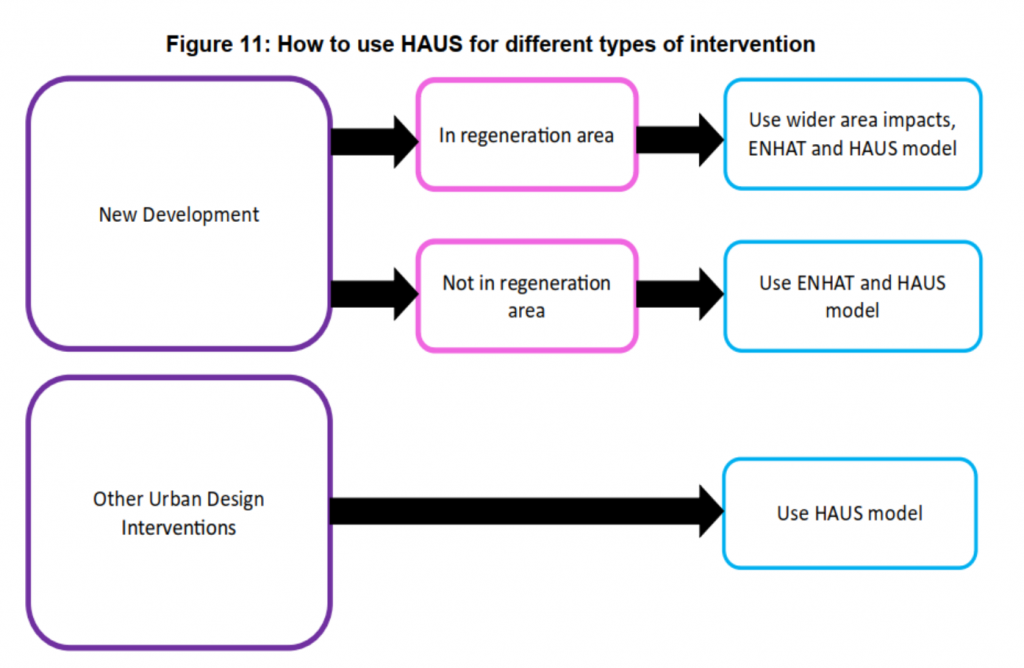
The guide already had advice on valuing the health and rough-sleeping impacts of additional rented affordable housing. The new bit this time is the ‘HAUS’ methodology for valuing a wide range of health impacts from new developments or urban design interventions. There’s some overlap with the transport scheme impacts covered in TAG, but HAUS comes from a different angle on these, as well as covering other areas such as other community infrastructure or building design. A pair of case studies about using this methodology has also been produced.
The final item on MHCLG’s list of updates is the reporting of value for money. Just as with DfT’s guidance (as I’ve mentioned before), this is a really critical bit of the process: it’s how the appraisal outputs get turned into a bottom-line view of whether the proposed policy or scheme is actually good value or not. I’m looking forward to digesting, over a cup of tea, exactly what’s changed and seeing how it compares to the DfT approach.
![Screenshot of some text from the MHCLG Appraisal Guide. The text is as follows, 3.69. MHCLG includes an explicit assessment of analytical robustness alongside VfM assessments. The level of robustness is divided into three categories based on considering how well the analysis meets the three aspects of quality – capability and capacity, models and data and reporting of uncertainty. It uses three summary categories to report on the robustness of the analysis: • Robust [that word shown in green] – meets all three criteria of capability and capacity, models and data and communication of uncertainty fully for the decision at hand; • Reasonable [that word shown in blue] – generally meets the three criteria of capability and capacity, models and data and communication of uncertainty for the decision at hand but some minor areas where improvements could be made; • Limited [that word shown in red] – serious concerns in one or more of the three criteria of capability and capacity, models and data and communication of uncertainty that impact adversely on the quality of the evidence presented. For example, this might include analysis being carried out by unqualified people, no quality assurance of analysis, poor data and failure to assess and/or communicate the uncertainty in the results.](https://grahamjames.co.uk/wp-content/uploads/2026/02/MHCLG-AG-robustness-text-1024x570.jpg)
Contains public sector information licensed under the Open Government Licence v3.0.
This post was updated on 27 February 2026 to clarify the origin of the Technical Annex.