 by
by Graham is unconvinced by the latest Green Book and TAG advice
The 2026 edition of the Treasury’s Green Book, and the consequential updates to DfT’s Transport Analysis Guidance (TAG), included a new sensitivity test for the discount rate that is applied to future costs and benefits.
This post is based on a text originally published in Local Transport Today in April 2026.[1] At the end, I have added a note on subsequent developments.
The new DfT TAG guidance on a discount rate sensitivity test, reflecting the latest Green Book, presents some strands to unravel.
Discounting is the process of reducing the weight or value we give to costs or benefits when they occur in the future rather than today. The further into the future they are, the more they are discounted.
In a Green Book-based appraisal we initially discount health-related impacts by 1.5% per year, and others by 3.5% per year. Both of these rates decline over time, but I’ll leave that out for simplicity.
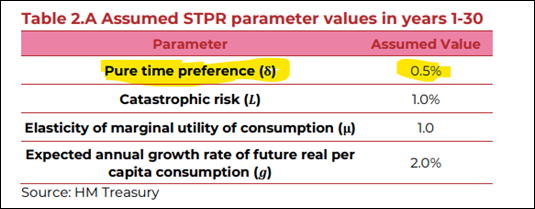
The Green Book approach reflects three reasons for discounting, which all contribute to the discount rate. One is that as society gets wealthier in the long run, the marginal value of a pound becomes smaller. This counts for 2%, but doesn’t apply to health impacts, which is why those differ. Another 1% reflects catastrophic risks. The third element, and the one in question here, is ‘pure time preference’. This is about society’s impatience: we would rather have benefits now, and put off costs until later. This is the final 0.5%.
The 2006 Stern review to government on The Economics of Climate Change picked up an issue – long-running in the depths of economic theory – about including the pure time preference.
Led by economist Nicholas Stern, the 700-page report’s central thesis was that the benefits of strong, early action far outweighed the costs. Put another way, the economic costs of inaction would be huge.
This was perhaps the most significant and long-lasting set of issues ever covered in a cost-benefit analysis: assessing the impacts of massive, practically-irreversible environmental changes and their human consequences such as large-scale displacement of populations. The review framed climate change not just as an environmental issue, but as the greatest and widest-ranging market failure ever seen. Unabated climate change could cost the global economy at least 5% of global GDP each year, and up to 20% or more if a wider range of risks is considered, Stern concluded. The cost of stabilising greenhouse gas concentrations, by contrast, was estimated at 1% of global GDP per year.
Stern felt it was unethical to allow the pure time preference to be applied in this context. It really meant people today cared more about themselves than about future generations, who weren’t getting a vote. Stern didn’t accept this, saying that future generations should have “the same claim on our ethical attention as the current one.” So Stern’s discounting calculations excluded the pure time preference element.
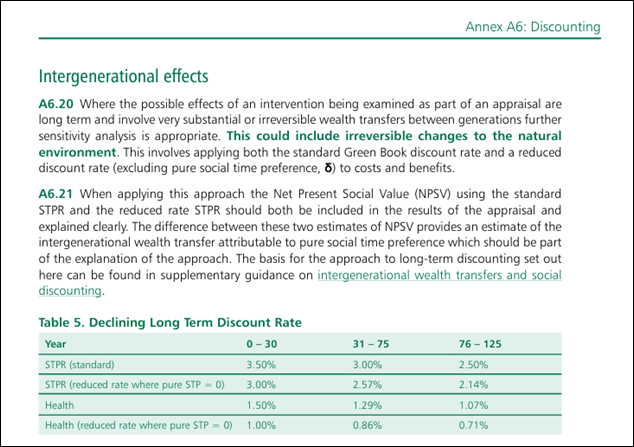
This thinking subsequently made its way into the Treasury Green Book, but was not reflected in TAG. Under the heading ‘intergenerational effects’, the Green Book said that where impacts are “long term and involve very substantial or irreversible wealth transfers between generations[,] further sensitivity analysis is appropriate. This could include irreversible changes to the natural environment.” That last sentence was in bold, perhaps as a hint to the situations the advice was really aimed at.
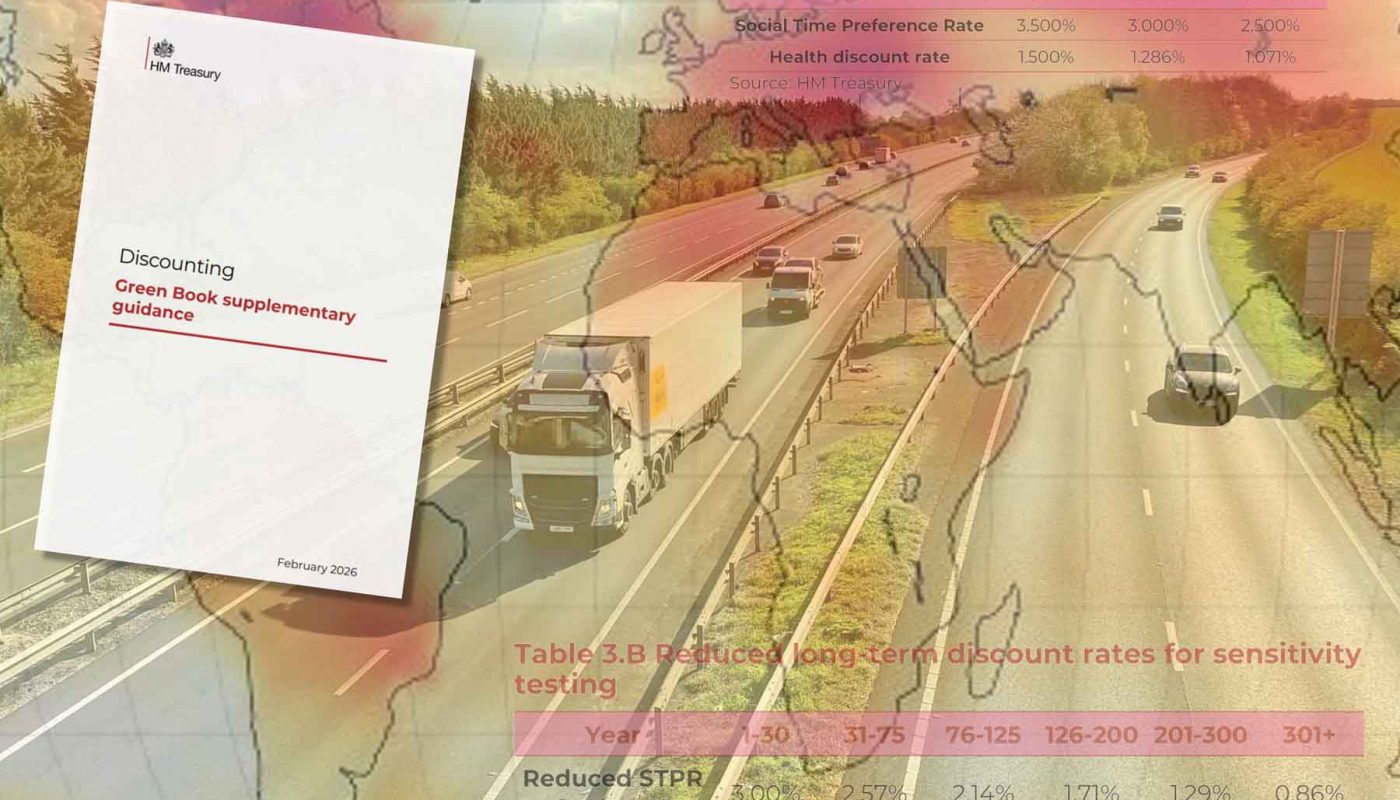
The advice in these cases was to run a sensitivity test with a reduced discount rate that excluded pure time preference (ie 1.0% for health impacts and 3.0% for the rest). The difference between the standard and reduced Net Present Value (NPV) figures represents the inter-generational wealth transfer.
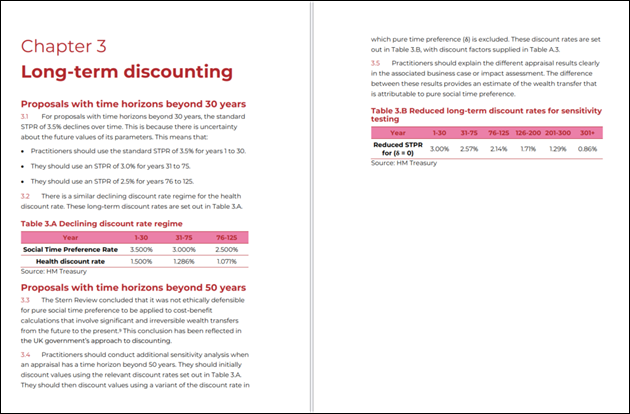
In the latest (2026) version of the Green Book, or rather the updated supplementary guidance where this advice now lives, the wording has considerably widened. The heading is now “proposals with time horizons beyond 50 years” and although the Stern rationale is still mentioned, the advice seems to be to run this sensitivity test for any appraisal with a time horizon beyond 50 years (which would include most infrastructure and building projects). However, the 1% sensitivity-test value for health impacts has disappeared.
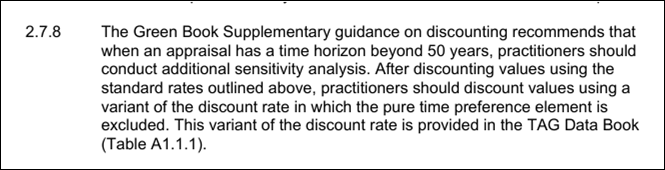
DfT has now carried forward the new Green Book approach into TAG. Many of our road and rail infrastructure schemes will now be caught by this. It will rarely be a lot of extra effort, but every little helps or hinders the process.
For a typical scheme with upfront costs and ongoing benefits, the sensitivity test (for which I would still run the health impacts at 1%) will usually increase the benefit-cost ratio (BCR). My dummy calculations suggest by around 15%. But it’s another version of the BCR to be put on the table and be confused by, or to cherry-pick according to preference or circumstances. It will generally have little real impact on decision-making. I wonder whether in most cases the extra effort would be better directed to taking uncertainty more seriously instead.
In any case, the Green Book change itself is curious. It doesn’t seem aligned to the original Stern point and the type of question it was being applied to.
In terms of carbon, it seems out of place for most appraisals. The UK appraisal philosophy (whether we agree with it or not) is that as we have legally-binding emissions targets, if a scheme increases carbon emissions then society will simply pay to reduce emissions by the same amount somewhere else in the economy (the ‘marginal abatement cost’). So in the world of appraisal, a project never actually has climate-related impacts.
Many of the other impacts we cover are much more reversible: our children or grandchildren can decide to close and grass-over the road or railway that we build, and apart from climate-change they will see results quickly.
Might it be wider than a climate-change issue? The Treasury has been under pressure from some stakeholders who see the discount rate as having a deleterious impact on appraisal outcomes for long-term transformational schemes. And there are respectable economic arguments for ditching the pure time preference factor. But this particular change seems out of the blue, especially as a wide-ranging review of the discount rate has been promised.
I wonder whether the previous advice has simply been mangled in the (laudable) attempt to shorten and simplify the Green Book.
If there’s a genuine view that the pure time preference factor means future generations are getting too little weight in appraisal generally, then we would need to consider how to address this. The Green Book’s sensitivity test approach might not be the best one. But the first question is: was the new guidance what was actually meant?
The findings of the Treasury-commissioned review of the discount rate, by Professor Mark C Freeman and Professor Ben Groom, were subsequently published in June 2026.[6] The recommendations included:
- Retaining the pure time preference factor, at 0.5% as it is today
- Removing discount-rate sensitivity analysis from the Green Book
- Dealing with issues of inter-generational fairness by separately reporting the time profile of undiscounted net benefit values, and (for some projects) conducting explicit welfare analysis outside the discount-rate framework
- Having a single, consistent discount rate calculation. This included removing the separate discount rate for health impacts, but instead reflecting the relationship between income and willingness-to-pay for health benefits within the calculation of benefits before applying discounting
As of the date of this post, the Treasury has not yet published its response to the review.
[1] Graham James, Stern thoughts on the revised advice on the sensitive matter of the discount rate, Local Transport Today, issue 937, 29 April 2026, p12.
[2] HM Treasury, Discounting: Green Book supplementary guidance, February 2026. Link
[3] HM Treasury, The Green Book: Central government guidance on appraisal and evaluation, 2022, Annex A6. Link
[4] HM Treasury, Discounting: Green Book supplementary guidance, February 2026. Link
[5] DfT, TAG Unit A1.1: Cost-benefit analysis, May 2026. Link
[6] Mark C Freeman and Ben Groom, Green Book Discount Rate Review: Summary of Findings and Recommendations, 30 June 2026. There is an accompanying Technical Annexes document. Link