 by
by What does the Chancellor’s discount rate announcement mean for transport projects?
The Chancellor announced today that the Green Book discount rate will be reduced from 3.5% to 3%.
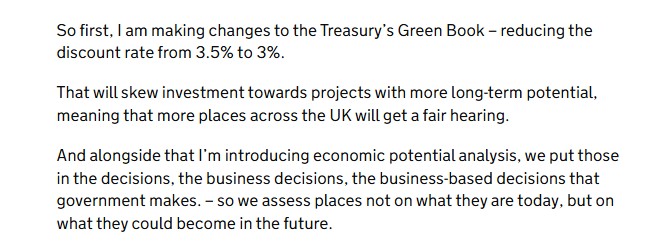
This is the ‘headline’ discount rate, which applies to non-health benefits up to 30 years into the future. There’s currently a separate, lower rate for health benefits, and both rates decline in blocks from year 31 onwards.
The previous episode in this storyline was the Green Book Discount Rate Review which the Treasury commissioned from two eminent Professors: Mark C. Freeman and Ben Groom. Their report was published in June.
![Screenshot extract form the review report. Text is as follows.
The Green Book applies the forward discount rates given in Table 1. These reflect a flat term structure for the risk premium (1% for all horizons for standard projects; −0.5% for social insurance projects) and a declining term structure for the risk-free rate:
[there then follows a table with a header row and two line items. The header row reads:]
Forward rate 0-30 years 31-75 years 76-125 years >126 years
[The line items then read:]
Standard projects 3.0% 2.5% 2.25% Explicit welfare analysis
Social insurance projects 1.5% 1.0% 0.75% Explicit welfare analysis
[The caption is:] Table 1. Recommended forward discount rates
[The text then continues:]
• These values are reviewed every five years, or sooner if there is clear evidence that forecasts
of economic growth have changed materially in the meantime.
• Considerations of, for example, specific environmental, health, and place-based effects are
accounted for in changes to welfare weights and/or relative prices. These lead to
adjustments in the estimates of expected net social benefits (social benefits minus social
costs) in the present value equation and not in the discount rate.](https://grahamjames.co.uk/wp-content/uploads/2026/09/image.png)
At the time of this post, the Treasury had not published its response to that review, nor the full updated guidance using the new rate. The headline change announced today is consistent with what the review recommended, but we can’t yet say for sure that the Treasury has accepted the review’s reasoning or accepted all the recommendations. There are still loose ends to be confirmed, around things like the declining profile from year 31, and whether (in line with the review’s recommendations) the curious sensitivity test excluding pure time preference will be abandoned. I’ll write more when we have the full details.
What’s the likely impact on the business case for a scheme?
The projects most affected are those where the costs are up-front and the benefits run on afterwards into the long-term. This includes most transport infrastructure schemes.
By my calculations, and assuming the declining profile will also follow the review’s recommendations, the benefit-cost ratios (BCRs) on this type of project will increase by about 16%. For some, this will be enough to take it over a ‘magic number’ and into a higher value-for-money category.
Will more spades be going into the ground?
But this doesn’t necessarily mean more projects will get built. Two reasons.
First, the BCR is rarely the only factor in a business case, or in the decision to build or not build. Many of us can probably think of schemes that went ahead despite a disappointing BCR, or vice versa.
Second, the available funding is still a constraint. Rarely is there an under-subscribed pot of money searching for schemes that hit a particular BCR benchmark. As one Minister put it last year: “there isn’t enough money to do everything”. The new discount rate, in itself, won’t change this.